First-Ever Experimental Demonstration of a Novel Beam Injection Technique for Ultracompact Storage Rings
A Significant Step Toward Next-Generation Precision Muon Measurements
A research group including Associate Professor Hiromi Iinuma (Basic Natural Sciences) from the Applied Atomic Science Division, Mr. Ryota Matsushita of the Graduate School of Science, The University of Tokyo, researchers from the High Energy Accelerator Research Organization (KEK), and The Graduate University for Advanced Studies (SOKENDAI) has successfully achieved the world's first experimental demonstration of beam storage in an ultracompact storage ring using a Three-Dimensional Spiral Injection scheme. The results have been published in Physical Review Letters (PRL).
DOI: https://doi.org/10.1103/8nxx-srgz
Storage rings are fundamental instruments in accelerator science. However, achieving high-precision measurements of short-lived particles such as muons requires storage rings to be significantly downsized. As storage rings become smaller, the revolution period of particles decreases to only a few nanoseconds, making conventional beam injection techniques increasingly difficult to implement.
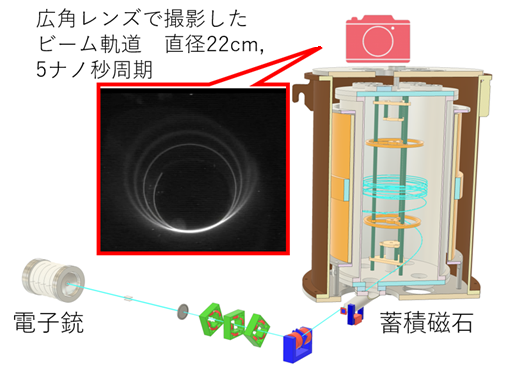
The Three-Dimensional Spiral Injection scheme, proposed and developed by Associate Professor Hiromi Iinuma and colleagues, is an innovative method that introduces a particle beam into a storage ring along a three-dimensional spiral trajectory, enabling efficient beam storage. Using an electron beam in an ultracompact storage ring with a revolution period of 4.7 nanoseconds, the research team successfully demonstrated for the first time in the world that this scheme works in practice. The experiment confirmed beam storage corresponding to more than 200 revolutions and showed excellent agreement with simulation results.
This achievement represents an important enabling technology for next-generation precision muon measurements, including the Muon g−2/EDM experiment underway at J-PARC, which aims to probe the properties of elementary particles with unprecedented precision. The technology is also expected to support a wide range of future applications of muons.
Research and Human Resource Development Achievements at RECAS
Ibaraki University promotes cutting-edge research and education in atomic science and quantum beam applications through the Research and Education Center for Atomic Sciences (RECAS), in collaboration with the Graduate Program in Quantum Beam Science of the Graduate School of Science and Engineering, J-PARC, and other research institutions in Japan and abroad.
One of the principal contributors to this research, Mr. Ryota Matsushita, is a graduate student at the University of Tokyo. He was accepted as a Special Research Student at Ibaraki University and carried out the research under the supervision of Associate Professor Hiromi Iinuma. Within the RECAS environment, where researchers and students from different institutions come together to tackle frontier scientific challenges, he gained extensive experience in all stages of the research process, including theoretical studies, experimental work, data analysis, and manuscript preparation, making a significant contribution to the completion of this study.
This achievement not only demonstrates the international competitiveness of research in the fields of atomic science and quantum beam applications, but also highlights the strength of RECAS in integrating advanced research with the education and training of the next generation of scientists.
Publication Information
Title: First Experimental Demonstration of Beam Storage by a Three-Dimensional Spiral Injection Scheme for Ultracompact Storage Rings
Journal: Physical Review Letters 137, 025002 (2026)
Publication Date: July 10, 2026
For further details, please refer to the press release and Ibaraki University News & Events:
- Press Release: https://www.ibaraki.ac.jp/news/uploads/2026/07/202607161000.pdf
- Ibaraki University News: https://www.ibaraki.ac.jp/news/n/2026/07/16014974.html