Development of a New Analytical Approach for Revealing Quantum Criticality Hidden Inside Superconductors
Toward Broad Applications in Quantum Materials Research
A research team including Professor Makoto Yokoyama of the Applied Atomic Science Division (Basic Natural Sciences) has published its latest findings in Physical Review Letters, one of the world’s leading journals in physics.
DOI: https://doi.org/10.1103/69mf-6r8f
Quantum critical phenomena are considered key to understanding the mechanisms underlying emergent states such as unconventional superconductivity and magnetism. They have attracted worldwide attention as fundamental phenomena closely related to the development of next-generation quantum materials. However, a longstanding challenge in this field is the use of chemical substitution, which is widely employed to tune electronic states. Because substituted atoms are not distributed perfectly uniformly throughout a material, measurements inevitably average over local variations, making it difficult to reveal the intrinsic nature of quantum-critical behavior.
In this study, the researchers focused not on the average composition of a sample, but on the local superconducting transition temperature (Tc), which reflects the local electronic state of the material. Using a scanning SQUID microscope, they measured superconducting properties on the micrometer scale and developed a novel analytical method that uses local Tc as a “natural yardstick” for characterizing variations in the local electronic state. This approach substantially reduces the effects of compositional inhomogeneity arising from chemical substitution, enabling the researchers to extract quantum-critical behavior within the superconducting state with unprecedented clarity.
The significance of this achievement extends beyond the discovery of a new phenomenon in a specific material. Rather, the study demonstrates a new research strategy for overcoming the intrinsic limitations of chemical substitution by exploiting information encoded within the material itself. This innovative approach provides a more direct means of investigating the essential nature of quantum criticality. The method is expected to be applicable not only to superconductors but also to a wide range of quantum materials, including magnetic and strongly correlated electron systems, thereby contributing to a deeper understanding of quantum materials and the development of novel quantum functionalities.
The research was carried out through a collaboration among Yusuke Iguchi (then at Stanford University), Kaede Inoh, Ryosuke Koizumi (Basic Natural Sciences), and Professor Makoto Yokoyama.
Publication Information
Y. Iguchi, K. Inoh, R. Koizumi, and M. Yokoyama
"Magnetic Quantum Criticality inside the Superconducting State Revealed by Penetration Depth Scaling with Local Tc "
Physical Review Letters, 137, 096001 (2026)
Related Links
- Ibaraki University Press Release
https://www.ibaraki.ac.jp/news/uploads/2026/08/PressRelease_MagneticQuantumCriticality_20260827.pdf - Ibaraki University News
https://www.ibaraki.ac.jp/news/n/2026/08/27015011.html
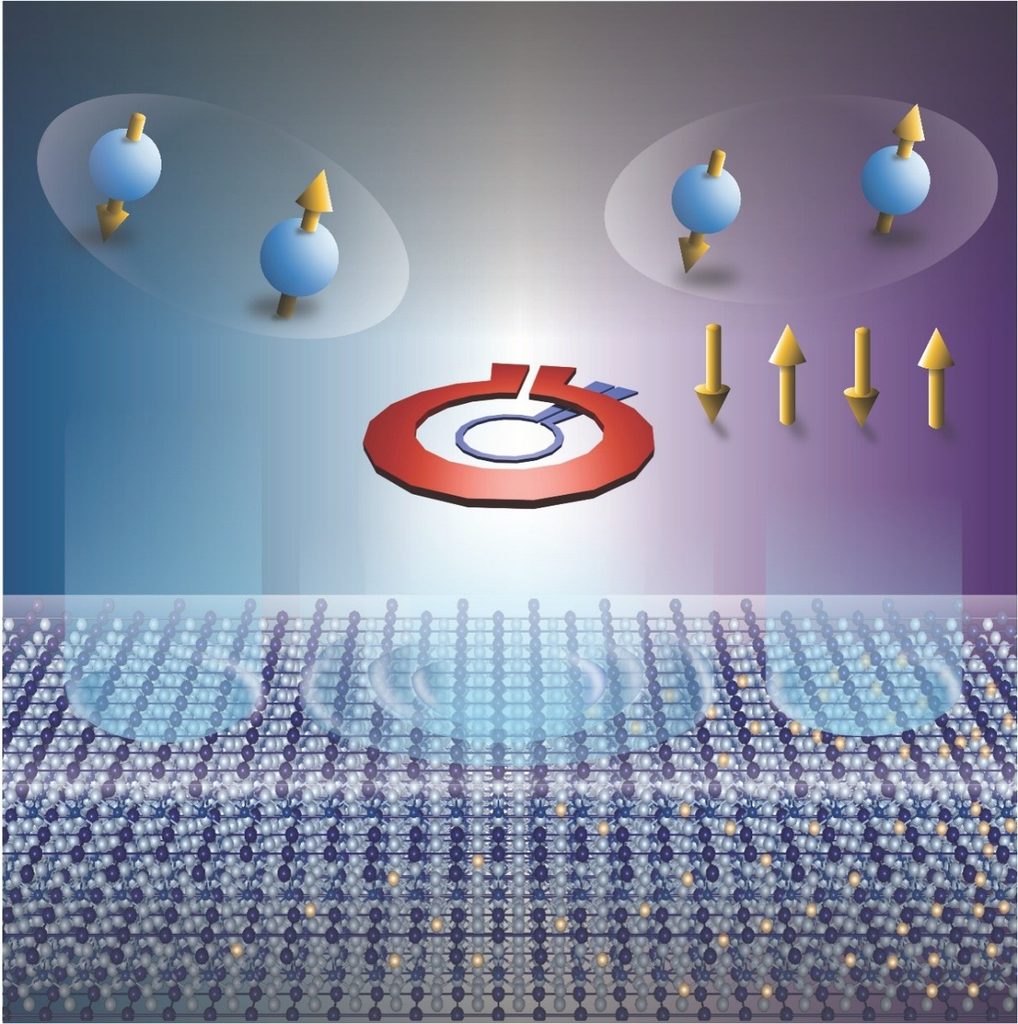
Figure: Schematic Illustration of the Research Concept
Using a scanning SQUID microscope, the researchers measured local superconducting properties on the surface of a sample at the micrometer scale. By employing the superconducting transition temperature (Tc) obtained at each location as a “natural yardstick,” they were able to reveal quantum critical behavior that had previously been obscured by compositional inhomogeneity arising from chemical substitution. This methodology provides a powerful new framework for investigating quantum critical phenomena and is expected to find broad applications across a wide range of quantum materials.