Selected for the Sakura Science Program
Promotion of Japan–India Joint Research Utilizing Quantum Beam Science
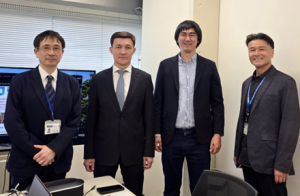
We are pleased to announce that an exchange program proposed by Professor Tomoki Maeda of the Applied Atomic Science Division at our Center has been selected for the FY2026 “Sakura Science Program” organized by the Japan Science and Technology Agency (JST).
This program falls under the Collaborative Research Activities Course (Course B) and is titled “Japan–India Collaborative Research on Technological Innovation in Sustainable Packaging Using Quantum Beam Science.” It will be conducted in collaboration with the Indian Institute of Technology Madras (Department of Chemical Engineering), one of India’s leading research universities.
■ Overview of the Exchange Program
This exchange aims to establish an international collaborative research framework by integrating our Center’s research in materials science using quantum beams with IIT Madras’s expertise in Sustainable packaging technologies.
Specifically, the project will leverage Japan’s strengths in:
- Nanomaterial fabrication technologies
- Nanoscale structural analysis using quantum beams (neutrons, X-rays, and electron beams)
These core technologies will be utilized to advance the development of next-generation environmentally friendly packaging materials.
■ Background and Objectives
At Ibaraki University, the “IBADAI Vision 2030” promotes the strengthening of research infrastructure with the aim of establishing world-class research centers in the fields of quantum beam science and environmental science. It also seeks to enhance its function as a hub for exchange with overseas researchers and students, thereby advancing the internationalization of education and research.
This exchange program, which contributes to the achievement of this vision, aims to generate innovative solutions to the development of environmentally friendly packaging—an issue common to both Japan and India—through the application of quantum beam science, while also strengthening international collaboration among early-career researchers.
■ Program Activities
During the exchange period, the following activities will be conducted through lectures, practical training, and joint research:
- Lectures and hands-on training on quantum beam science and related technologies
- Nanoscale structural analysis using small-angle X-ray scattering and electron microscopy
- Fabrication of nanomaterials and their incorporation into polymer materials
- Evaluation of film properties (e.g., gas barrier performance)
- Visits to advanced research facilities such as J-PARC and the KEK Photon Factory
In addition, collaboration with domestic research institutions will facilitate interdisciplinary research discussions and foster international networking among young researchers.
■ Expected Outcomes
The program is expected to achieve the following outcomes:
- Creation of scientific and technological innovations in environmentally friendly materials
- Development of young researchers capable of leading international collaborative research and promotion of global knowledge circulation
- Enhanced utilization of large-scale advanced research facilities
- Strengthening of continuous research and educational collaboration between Japan and India
■ Future Prospects
Building on this initiative, we aim to further deepen collaboration with IIT Madras through continued joint research and academic output. We will also expand opportunities for Ibaraki University students to participate in international research activities, fostering globally minded human resources.