Revealing a “Vortex-Like Magnetic Structure” Hidden in a Chiral Crystal Structure
— Discovery of Magnetic Toroidal Order in Nd₃Ir₄Sn₁₃ —
A collaborative research team led by Professor Kazuaki Iwasa and Professor Keitaro Kuwahara (Basic Natural Sciences), together with Associate Professor Akinori Hoshikawa (Applied Science and Engineering), from the Applied Atomic Science Division, has published their research results in the Journal of the Physical Society of Japan.
(Article DOI: https://doi.org/10.7566/JPSJ.95.044711)
Magnetism originates from magnetic moments, which act as tiny magnets associated with individual atoms. In crystalline solids, these magnetic moments are arranged according to specific rules, and their spatial arrangement patterns can be extremely diverse. Such magnetic structures are known to have a strong influence on material properties such as electrical conductivity and heat capacity. Therefore, understanding magnetic ordering in detail is a key step toward discovering and designing new functional materials.
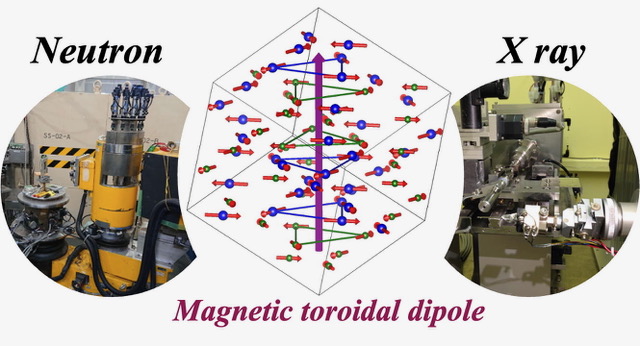
In this study, the researchers focused on the antiferromagnetic compound Nd₃Ir₄Sn₁₃ and investigated where the 48 neodymium (Nd) ions are located within a crystallographic unit cell and how the Nd-ion magnetic moments are arranged (shown as red arrows in the figure). To achieve such atomic-scale structures, they performed high-precision diffraction experiments using two types of quantum beams—neutrons and synchrotron X-rays—and successfully determined the chiral symmetry crystal structure and the magnetic structure with unprecedented detail.
As a result, the team discovered that the magnetic structure includes a unique component in which the magnetic moments form vortex-like arrangements on a triangular lattice. This swirling magnetic configuration is known as a magnetic toroidal dipole and is illustrated in the figure by purple arrows indicating the direction of the vortex.
The magnetic toroidal dipole was identified by applying the augmented multipole theory, which provides a general representation framework for distributions of electric charges and magnetic poles. Introducing this augmented multipole perspective enables a systematic analysis of hidden magnetic orders that are often overlooked within conventional descriptions of magnetism. Based on these findings, the material is expected to exhibit novel physical properties arising from the coupling between electricity and magnetism—so-called cross-correlation effects, such as magnetization induced by an electrical current.
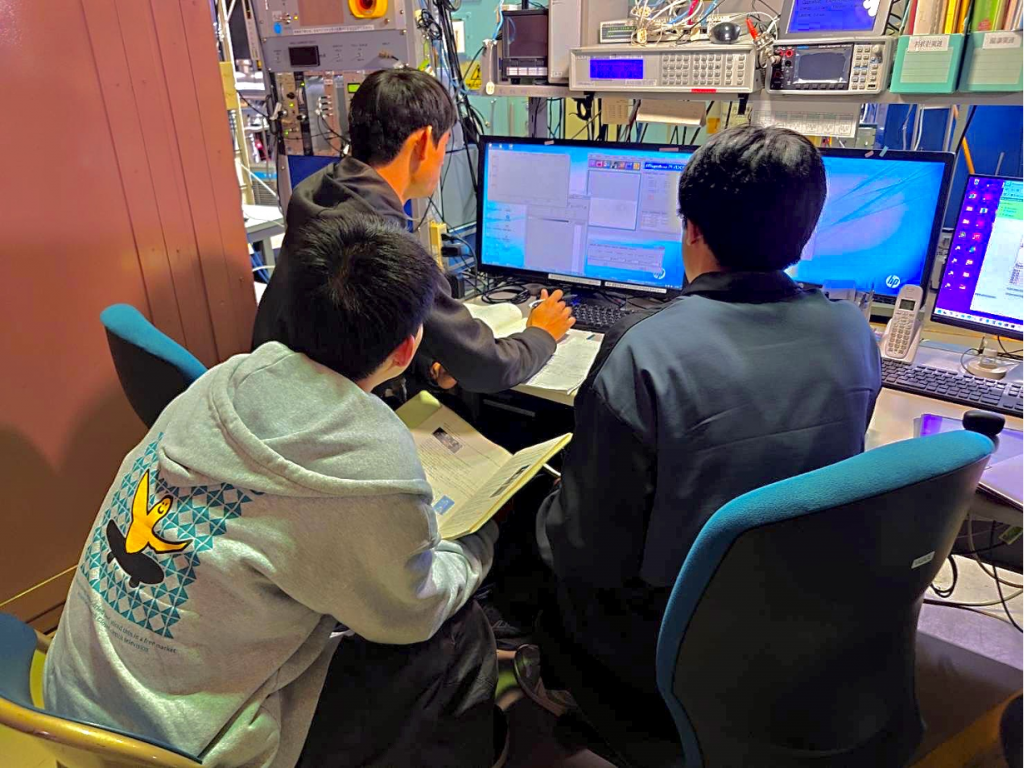
This research was carried out primarily by students of Ibaraki University (photo). The experiments were conducted using the X-ray diffraction beamlines BL-4C and BL-8A at the Photon Factory of the Institute of Materials Structure Science, High Energy Accelerator Research Organization (KEK); the neutron diffractometer iMATERIA (BL20) at the Materials and Life Science Experimental Facility of J-PARC, operated by the Japan Atomic Energy Agency (JAEA); and the neutron scattering instrument HQR (T1-1) installed at the JAEA research reactor JRR-3, operated by the Applied Atomic Science Division under an agreement with the Institute for Solid State Physics, The University of Tokyo.